OneThe first one was drawn in the sand.
I was a girl when the rebels came for our city. A man from our compound — someone who had once worked for the government — led twenty-two of us out through the bush. No one appointed him. The adults simply trusted him, because in that time and place a man like that was believed to know more than the rest of us. So we followed. And I followed most carefully of all.
He did not hand us safety. He could not. What he handed us was a system — three rules he drew in the sand with a stick, or with his finger when there was no stick, so that we could see them and carry a picture of them in our minds.
- When the bomber jets come, look up and run toward them — not away.
- When you hear gunfire, never stand to run. Crawl, flat against the ground.
- Be kind to everyone you meet. You never know who they will become tomorrow.
I ran toward the planes. I crawled when the shooting started. And on the days fear made me forget, I closed my eyes and saw the drawings in the sand, and I remembered. I believe, next to God's grace, that system is why I survived when so many did not.
One morning, hiding in a house the grenades had already destroyed, we heard the rebels coming. They took all the boys to join them. Three weeks later I was held at gunpoint for walking through a yard meant only for soldiers. A boy far smaller than me pressed a gun to my head. My little cousin was crying, screaming my name. A truck came speeding up, soldiers jumped out, and the boy said, "Commander, this one was breaking the rules."
The commander turned around. And he said one word.
I said, "Yeah." And he ran to me. He told the soldier to get away from me. He was one of the boys from our group. "Stay with me," he said. "You were always so good to me. When I was scared to go outside at night, you always came with me, and you never said anything to the others."
I had no idea he had even noticed. Rule three had just saved my life — a kindness I had offered without knowing, returned at the exact moment I needed it most.
TwoThe second agreement was posted on a wall.
I carried that lesson to America and walked into a well-established development group as the least likely person in the building. A rookie. A woman. An African woman from a war-torn country, my English still finding its full stride. Not who a firm like that usually hired. The man who ran it took a real risk bringing me on as a commercial broker, and he told me so. I knew what was being asked of me in return.
In those first months, every mistake I made, I heard through the office door in that slow, beautiful Southern drawl. "Viiiiidaaaa." I would walk in, sit down, and he would calmly point out the misstep — and then walk me back into the fax room, where the firm's standards were posted on the wall for everyone in the building to see. Professionalism. Conduct. Communication. The same simple list for every single person.
I was frustrated. I was embarrassed. Some days I felt crushed. But I was never confused — because I had a standard I had signed my name to, in a room I could walk back into any time I lost my footing. I did not need him to teach me accountability. The agreement was already teaching me. He was just the calm voice pointing me back to it. And I held to it even though, in commercial real estate, you are not paid until you close. I did the work because I had agreed to it. The system did the teaching.
Seven, ten years later I was a commercial broker and developer at that group — sitting on city boards, meeting with mayors and senators, helping lead developments that shaped the city, with some of those leaders coming to me for advice. Me. A girl a therapist had once gently warned, "Girls like you are lucky to even make it out of high school." I remember thinking, thank God she is not God. I had built a real career. A real reputation. Real success.
ThreeThe third agreement, I had to build myself.
Because every evening I drove home from that success and struggled to hold my family together. My eight-year-old son and I argued every day. Chores. Schoolwork. Responsibilities. The same loop, the same rising tone that did not match the woman I had been at the office that morning. I could close a million-dollar deal. I could not get my son to bring his backpack inside.
The part nobody sees3:14 a.m.
People think healing looks peaceful. It did not look that way in my house. It looked like a grown woman waking at three in the morning unable to recognize her own bedroom — chest tight, heart slamming, not sure if she was in America or back in the war.
Some nights I slept. Some nights I sat on the edge of the bed until sunrise, too afraid of where sleep would take me. And then six o'clock came anyway — little footsteps in the hallway, cabinets opening, cartoons humming, my son asking where his shoes were — because motherhood does not pause for trauma. And every single morning, I made myself become her: the mother they needed.
There were days the worst of me wanted to stay in the room and break things. Loving them was walking out instead — that three-second choice between who pain had built and who love was still building. I did not have the words for it yet. But I was already practicing the thing I would one day name: Strong Back, Soft Front Parenting™.
It came to a head one ordinary morning. My son and his father were deep in a hard back-and-forth. My son stormed out crying and walked toward the car where I sat waiting to take him to school. My whole body dropped — that familiar drop. And I heard the words I always heard in those moments: I am failing my family. His father called after him, "If you don't want to be told what to do every day, then do what we ask you to do!"
My son stopped. He turned around. And through real tears he said the sentence I have never been able to forget.
Every day feels like something new!" My son, eight years old
I did not move. Because I had been those words. In my first months at that firm, every day had felt like a test I did not know I was taking. And what saved me was not someone explaining the rules again and again. What saved me was a room, with a list on the wall, that I had signed my name to.
My son had two parents who loved him completely — and a moving target for what was expected of him. He was not failing. We were not failing. We simply did not have a system.
I said it out loud, almost to no one. "Oh my God. That's it." My son looked up. "You okay, Mom?" I put my hand on his. "We're okay, sweetie. We're okay."
And on the drive to work that morning I understood the thing that changed how I parented from that day forward. My family was not broken. My son was not the problem. I was not failing. We were a successful family doing the hardest job of our lives without the one thing every successful organization runs on — a clear, consistent, agreed-upon system that everyone can see.
So I did the only thing I knew how to do. I gave my home what the sand and that fax-room wall had given me: a system we could see, and agree to, together.
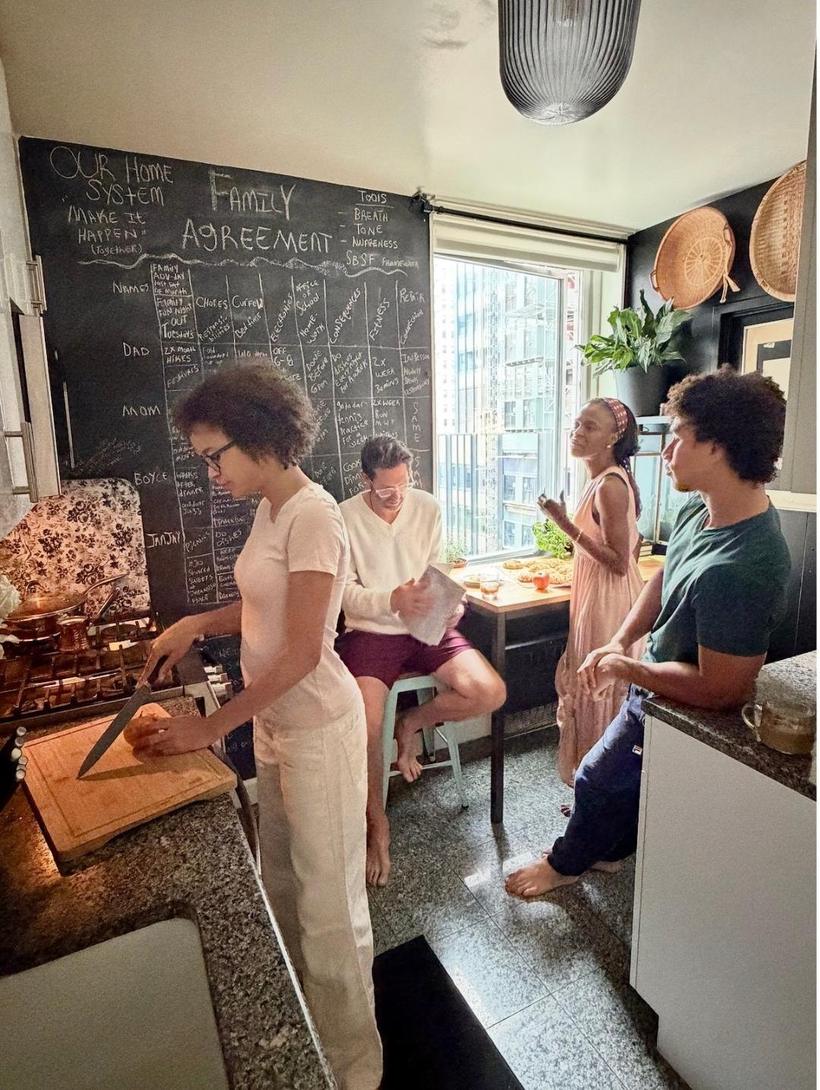
I got clear on who we were raising and put it where I would see it every morning. We sat down as a family and built our expectations together — and signed them. And I learned to hold the line and the love at the same time.
The talkbacks faded. The mornings got loud again — loud laughs and calm connection. The house started running on the system instead of on my last nerve.