9 Chores That Change a Teenager, and Why
Not the ones that keep your house tidy — the ones that build a person who can run their own life in four years.

Most chore lists are written for the house. Take out the trash, empty the dishwasher, do not leave your shoes there. Useful, and none of it changes your teenager.
The chores that change a teenager are the ones with a consequence attached to someone other than them. Not a punishment — a consequence. If your son does not fold the towels, nothing happens to anybody. If your son does not cook Thursday, the family does not eat on Thursday, and he finds out what it feels like to be depended on.
A chore is not about the task. It is about being the person the house is counting on.
Regular household chores are associated in the research with stronger executive function — planning, sequencing, initiating, finishing. That work has mostly been done with younger children, and it shows an association rather than proof of cause. But those are the exact capacities the teenage brain is still building, and they do not develop from being told about responsibility. They develop from carrying some.
There is also something a teenager gets from being needed that they cannot get from being praised. Praise is something you do to them. Need is something they do for you. A teenager who believes the household would notice their absence sits differently at the table.
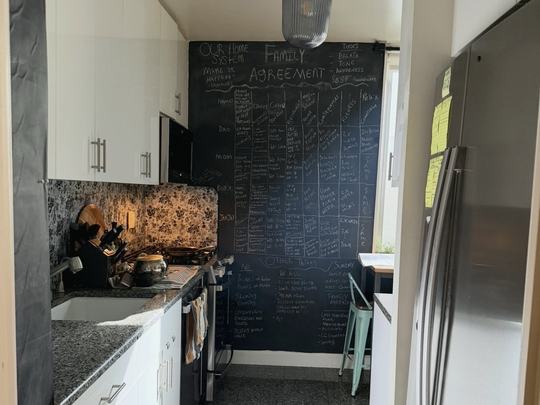
Do not announce it. Write it down together, in the meeting, with the consequence attached and everybody’s name at the bottom. Let them choose between options where you can. A teenager who picked Thursday will cook on Thursday. A teenager who was assigned Thursday will spend Thursday arguing about Wednesday.
And then let it be imperfect. The meal will be bad. The laundry will go in with a red sock. Say nothing. The competence comes second, and it only comes if you can survive the first six weeks of it being done badly.
The board, the agreement everyone signs, the 30-minute meeting script and what to do in week two when it gets tested.
Start With The Family Agreement →
Get my free 5-Minute Family Agreement Conversation Starter, then receive one Encouragement Phrase Card each week — simple words to keep you and your teen encouraged, connected and supported through the hard moments.
Grades are an outcome. Effort is a behavior. Most families fight about the first and never describe the second — and that is the whole problem.

Most parents do not have a communication problem. They have a first-sentence problem. Here are twelve openings that keep a teenager in the room.

Not written down means negotiable. Here are the eight things that stop being an argument the moment they are on a board everybody can see.
Send me what is happening in your house. I choose one question at a time and work it through on the newsletter — the situation, the words to say, and what to do when it gets tested. If I choose yours, I email you a week before it goes out.
Ask Vida